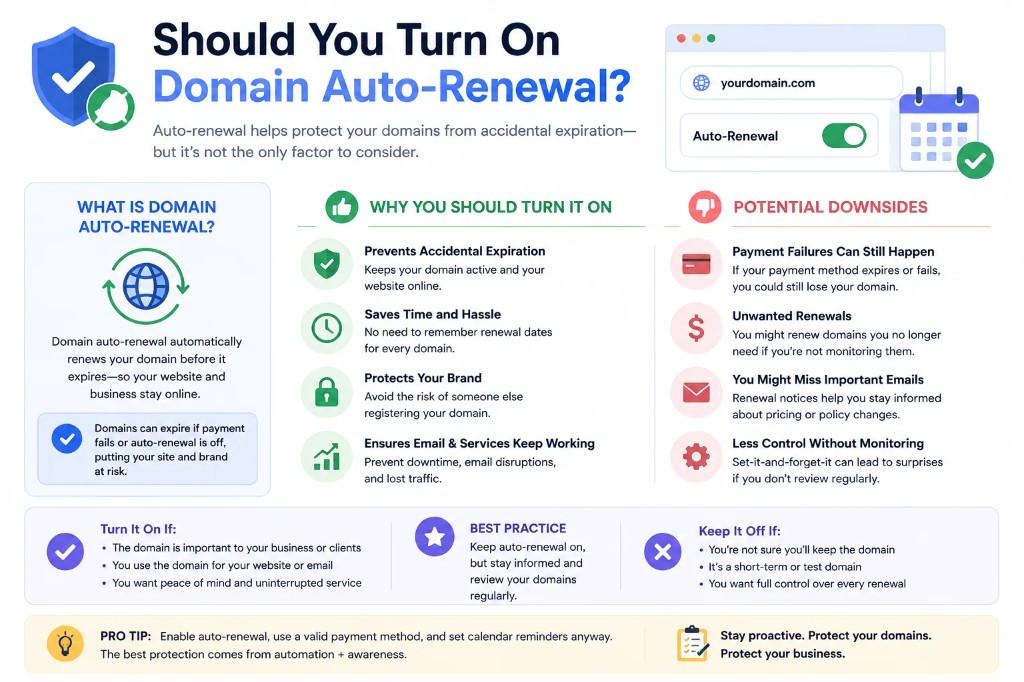
Auto-renewal feels like the obvious fix for missed domain renewals: turn it on once, and never think about it again. In practice, it removes one failure point while leaving several others in place — which is why agencies still lose domains even with auto-renewal enabled.
The Case for Auto-Renewal
- Removes the need to manually initiate every renewal
- Reduces the risk of forgetting a date entirely
- Usually the registrar's default recommendation, and reasonable for most domains
Where Auto-Renewal Still Fails
- Expired payment method. If the card on file has expired, auto-renewal silently fails — and many registrars only notify the account holder, not the agency managing the domain.
- Client-owned accounts. If a client owns the registrar account and turns off auto-renewal (or never enabled it), the agency has no control over it at all.
- Domain transfers and account changes. Auto-renewal settings don't always carry over cleanly during a registrar transfer.
- Multiple domains, inconsistent settings. Across dozens of client domains and several registrars, it's common for auto-renewal to be enabled on some and quietly disabled on others.
- False sense of security. Auto-renewal being "on" is not the same as a renewal having actually succeeded — nobody is checking unless something is monitoring the outcome.
The Right Way to Think About Auto-Renewal
Auto-renewal is a useful safety net, not a complete solution. It reduces the chance of a missed renewal but doesn't eliminate the need to verify that renewals are actually happening. The agencies that get burned are usually the ones that treated "auto-renewal is on" as the end of the process rather than one layer of it.
A More Reliable Combination
The most resilient approach combines both: enable auto-renewal where possible as a first line of defense, and track the actual expiry date independently as a second line — so a failed auto-renewal still gets caught before the domain lapses. Duvento is built for exactly this second layer: it tracks the real expiry date for every client domain and sends a reminder ahead of it, regardless of whether auto-renewal is supposed to be handling things automatically.
The Bottom Line
Auto-renewal is worth enabling, but it isn't a substitute for actually knowing when a domain expires. Treat it as a safety net with holes in it — not a reason to stop tracking the date yourself.